What an Ingredient List Can Tell You Before You Buy
Learn how to read an ingredient list, compare formula clues, and screen for ingredients you prefer to avoid without treating the label as a promise.
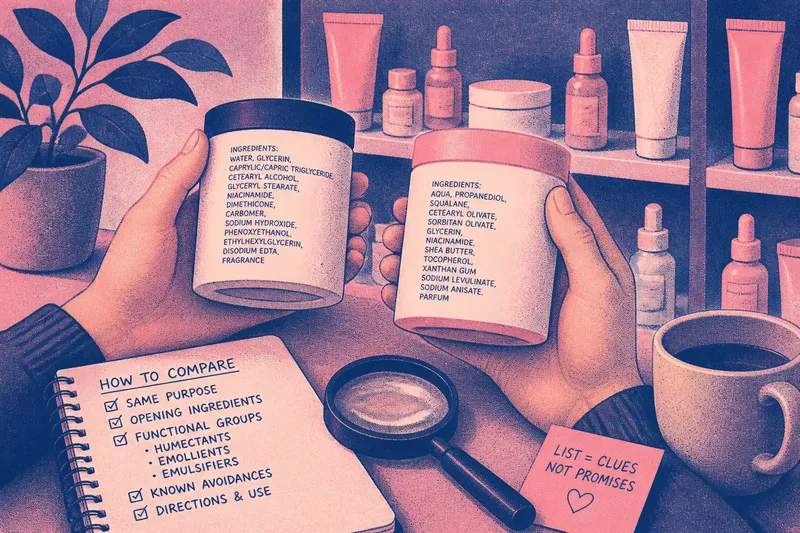
At a store shelf, two face creams can promise similar comfort while listing very different materials. Reading an ingredient list can help you compare their formulas and decide what to investigate next, though it cannot predict exactly how either will feel on your skin.
How ingredient lists are arranged
In many markets, cosmetic ingredients appear in descending order by weight until the formula reaches a low-concentration threshold; ingredients at or below that level may be listed in a less strictly ordered group. Rules vary by market and product type, so the label’s jurisdiction matters.
The first few entries usually offer the clearest picture of a product’s base. A water-based lotion may begin with water, followed by ingredients that help bind water, soften skin, or give the product texture. The list is not a complete recipe: it does not disclose exact amounts or every detail of how ingredients were combined.
Order helps with broad comparison, not fine ranking. If two products list the same ingredient near the top, that alone does not establish that they contain the same amount or will behave alike. The rest of the formula, including its structure and packaging, can change the experience.
What the first few ingredients can suggest
The opening entries can hint at a formula’s basic character. Water often appears in lotions and gels; oils, waxes, or fatty alcohols may contribute softness or body; and solvents can help dissolve other materials. These are clues, not fixed categories: an ingredient can serve more than one purpose.
Look for groups rather than treating each name as a verdict. Humectants such as glycerin are used to attract or hold water, while emollients help give a smoother, more supple feel. Thickeners and emulsifiers can shape a product and help keep oil and water components mixed. Recognizing one name does not reveal the whole formula’s texture or suitability.
Think of the list like the ingredients on a soup label: it tells you what went into the pot, but not the cook’s exact method or how the finished dish will taste to you. The analogy has limits, since cosmetic formulas are designed for use on skin and may combine materials in ways a food list does not explain.
Why ingredient order cannot give exact amounts
Usually, you cannot tell precisely how much of an ingredient a product contains. Ingredient order gives a broad indication for much of the list, but the label does not provide a concentration for each entry. Once ingredients fall into the low-concentration portion, their relative order may not show which is present in the greater amount.
That distinction matters when a product’s front label highlights a familiar ingredient. Its presence is information, but it is not enough to infer its dose, role, or effect. A product name or highlighted claim may describe a feature the maker wants to emphasize; the ingredient panel provides a different kind of information.
Say you are comparing two moisturizers because one names niacinamide prominently. If niacinamide appears near the end of its list, you can note that it is included, but you cannot calculate its concentration or infer what your skin will do. You might compare the complete lists, read the product directions, and decide whether the overall formula suits your preferences.
How ingredient lists can help with fragrance and sensitivities
An ingredient list can help you identify listed fragrance ingredients and substances you already know you prefer to avoid. Terms such as “fragrance” or “parfum” may represent a fragrance blend rather than name every component on the package; labeling conventions can vary. “Unscented” also does not necessarily mean that no fragrance-related material is present.
If you have a known allergy or a history of reactions, compare the complete label with advice from a qualified clinician, such as a dermatologist or allergist. A product labeled “natural” or “clean” is not, by that wording alone, a reliable indication that it will be less irritating. Ingredient lists describe contents, not an individual’s tolerance.
When a decision depends on exact label terminology, check the package and manufacturer information; ingredient disclosure rules also depend on local requirements. For personal medical concerns, ask a qualified professional rather than relying on a label alone.
What ingredient order says about a product’s likely performance
Ingredient order cannot tell you whether a product will work for you. The list names materials in a formula, but it is not a forecast of personal results. Performance can depend on the complete formulation, how the product is used, the condition of your skin, and your own response.
Be cautious with claims that a single ingredient automatically makes a product effective or unsuitable. The same ingredient can behave differently in different formulas, and a long list is not inherently better than a short one. Treat package claims and the ingredient panel as separate clues: one describes what the product is meant to do, while the other names its listed components.
How to compare two ingredient lists
Compare products that serve the same purpose, then examine their bases, texture-related ingredients, and any ingredients you specifically want to seek or avoid. Read the entire panel rather than searching only for a headline ingredient. If a familiar name appears in different forms, check the exact spelling rather than assuming the terms are interchangeable.
- Check the product type: If both products serve the same purpose, compare their lists directly; if one is a cleanser and the other a cream, compare them only for a specific shared concern rather than treating them as substitutes.
- Check the opening entries: If the first ingredients suggest a water-rich base and that suits your preference, keep the product in consideration; if you want a richer-feeling product, compare it with an option whose opening entries include oils or waxes.
- Check for functional groups: If you recognize humectants, emollients, thickeners, or emulsifiers that fit what you want, note them as clues; if their roles are unclear, consult reliable product information instead of assuming what the formula will feel like.
- Check known avoidances: If the full list contains an ingredient you have been advised to avoid, set the product aside and consult your clinician if the reason is medical; if it does not appear, remember that label wording and local disclosure rules may still matter.
- Check directions separately from claims: If the directions fit how you intend to use the product, consider it on that basis; if they do not, choose an option with directions better suited to your intended use.
- Check highlighted ingredients against the full panel: If a promoted ingredient appears, treat that as confirmation of its presence only; if you need to know its concentration or role, seek product information from the manufacturer rather than estimating from the list.
This method helps narrow a choice without turning the label into a scoring system. A list may help you rule out a known concern or understand why a formula might feel richer or lighter, while leaving personal comfort to your informed judgment.
What should I check before choosing a product?
Does “fragrance-free” mean the same thing as “unscented”?
Not necessarily. Label wording can be used differently, and “unscented” may describe the perceived smell rather than the absence of every fragrance-related ingredient. If fragrance matters to you, check the ingredient panel and product information.
Can I identify every ingredient by its technical name?
Not always, and unfamiliar wording does not by itself signal a harmful substance. If a particular ingredient matters to your decision, consult reliable product information or ask the manufacturer what the listed term refers to.
Does a shorter list mean a gentler formula?
No. List length does not establish how a product will feel or whether you will tolerate it. The ingredients, the formula as a whole, and your own sensitivities matter more than a simple count.
Can the list tell me whether a product is right for my skin?
It can help you compare formulas and screen for ingredients relevant to your preferences, but it cannot settle personal suitability. For a medical skin condition, recurring reactions, or known allergies, ask a qualified professional for individualized guidance.
Before buying, use the ingredient list to answer a modest but useful question: does this formula contain anything you need to avoid, and does its overall composition fit what you want from the product? That is the practical value of learning how to read an ingredient list. It gives you a clearer basis for choosing without asking a label to promise how your skin will respond.