From Kohl Pots to Compacts: The Changing Shape of Portable Makeup
Portable makeup containers reveal how kohl pots, mirrored compacts, and capped tubes shaped cosmetic rituals, privacy, and the way people carried their beauty routines.
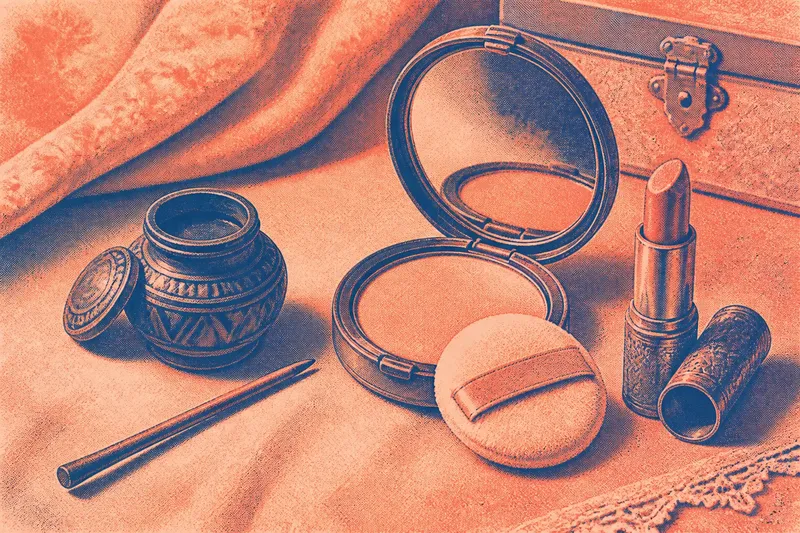
A kohl pot on a dressing table calls for a different gesture than a compact opened on a train platform. Portable makeup containers are more than vessels: their openings, closures, and surfaces shape how cosmetics are applied and how the ritual appears in shared spaces.
Kohl pots paired product with an applicator
In many historical depictions and surviving objects, kohl is held in a small vessel and applied with a separate stick or rod. The container and tool form a set: the opening holds the cosmetic, while the applicator transfers it to the eye. Specific designs and materials vary across places and periods, so a single pot cannot stand for every kohl tradition.
Using a vessel and separate tool requires a deliberate sequence: open the pot, handle the applicator, and put both away afterward. Portability here means that an object can be moved or carried; it does not necessarily imply a fast touch-up or use in public.
The opening also offers clues about the product’s intended handling. A narrow neck can help contain loose material, while a wider mouth may allow easier access with a finger or tool. These are design possibilities rather than a complete guide to an object’s original use; context and material matter too.
Domestic containers did not always belong to one user
A cosmetic vessel might sit among grooming objects in a household or dressing area, then move to another room or travel with its owner. Without evidence about a particular object’s context, it is difficult to say whether it was intended for one person, shared use, or a specific setting.
Smallness alone does not establish that a container was a personal accessory. The distinction between a vessel kept at home and an object carried for use elsewhere depends on more than size: a fitted case, attached mirror, secure closure, or paired applicator can suggest different practical priorities, though none proves how an individual used it.
Think of the difference between loose keys and keys gathered on a ring. The ring does not change what the keys do; it organizes how they are held and reached. A container with an attached mirror or a place for an applicator similarly gathers parts of a cosmetic ritual, without telling us exactly who carried it.
A compact made inspection part of the case
A hinged compact can bring a powder pan and mirror together. Opening it creates a sequence: look, pick up product with a puff or brush, apply, and close the case. The attached lid stays with the base, while the case gives the hand something firm to hold.
That arrangement suits pressed powder used with a dry applicator. A small mirror can help with a localized adjustment, though its limited view may not show the whole face at once. The design links product and inspection rather than simply making a container smaller.
Some compacts were also decorated with polished metal, engraving, enamel, or ornamental clasps. Such details could make a case a visible personal object as well as a tool. Their meaning depends on the object and its setting; decoration alone cannot establish who owned it or how often it was used.
Opening a case can make a private ritual visible
A compact designed to open and close readily supports a brief routine in a shared place: a glance in the mirror, a small application, and a closed case. This can make the action feel contained, but it does not make it invisible to people nearby.
The closed case hides its contents; the open one reveals both product and gesture. A mirror offers a moment of self-inspection in a public setting, while also making the act of checking one’s appearance visible. Portability therefore changes where a cosmetic ritual can happen without removing its social dimension.
Other formats organize gestures differently. A capped lipstick exposes a solid stick for direct application; a bottle holds liquid behind a closure; a jar may call for a finger or separate tool. These forms are not simply successive stages in a single history. They are different solutions for different products and ways of handling them.
What do portable makeup containers reveal?
Why might a compact have a mirror?
A mirror lets someone inspect an area while using the case, rather than relying on a separate dressing mirror. Its size and position shape what can be seen, so it may suit a localized adjustment better than a full-face view.
Why use a separate applicator?
A stick, brush, or puff can transfer a product that is loose, soft, or awkward to handle directly. It also adds an object that must be stored and kept clean, making the applicator part of the container’s practical design.
Does a small container prove it was carried in a bag?
No. A small vessel may be easier to move, but size alone cannot establish its intended setting. Closures, fittings, wear, material, and archaeological or historical context can offer clues, but interpretation should remain cautious.
Can decoration tell us who owned a compact?
Decoration can show that appearance mattered to the object’s design, but it does not identify an owner by itself. Inscriptions, provenance, and other contextual evidence would be needed to support a claim about ownership.
Read the design without treating it as proof
When looking at a portable cosmetic object, start with what can be observed: its opening, closure, materials, fittings, and any paired tool. Then separate those features from interpretation. A hinge may make repeated opening easier; it cannot, by itself, tell us where the case was used or by whom.
- If a vessel has a narrow opening, note that it may limit access; compare it with the product’s form before inferring how it was used.
- If a case has an attached mirror, record that inspection was built into its design; do not assume it was used in public.
- If an applicator is present or a fitting appears designed to hold one, consider the tool part of the object; if no tool survives, leave its original form uncertain.
- If a closure is secure and intact, note that it could help contain the contents; if it is damaged or missing, avoid claims about how safely the object traveled.
- If ornament covers the lid, describe its material and pattern; if ownership is at issue, look for provenance or other evidence rather than inferring an owner from decoration.
- If the object’s date or place of origin is uncertain, state that uncertainty; if reliable context is available, use it to narrow the interpretation without generalizing to every container of its kind.
Say you are examining an invented, hypothetical compact with a hinged lid, a small mirror, a powder pan, and a worn clasp, but no record of where it was found. First, describe those visible features without assigning an owner. Next, note that the mirror and pan bring inspection and powder together, while the clasp’s wear suggests repeated handling but does not establish where it happened. The resulting interpretation is limited but useful: the design supported a self-contained powder ritual, while the compact’s user and setting remain unknown.
The phrase portable makeup containers covers objects that make different gestures possible, from using a separate stick at a kohl vessel to opening a mirrored compact. Reading their shapes carefully can show how product, tool, and inspection were arranged; keeping observation separate from assumption makes that reading more reliable.