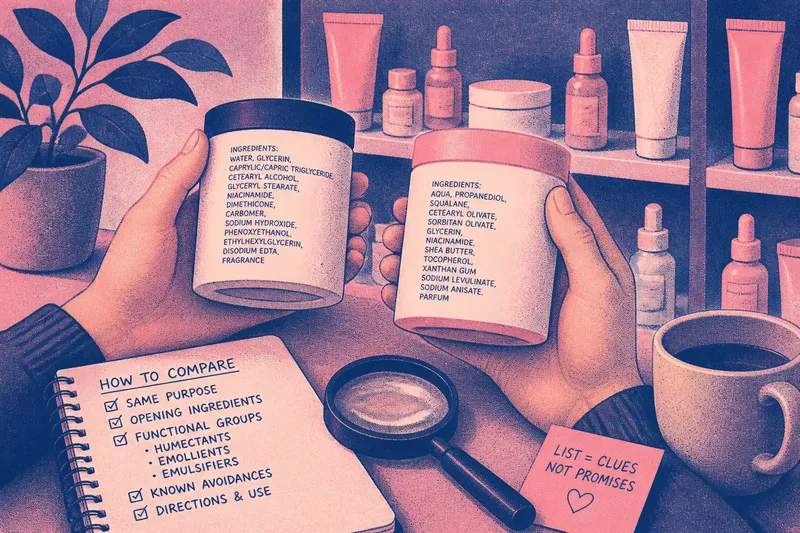
The More Steps, More Care Assumption
A thoughtful skincare routine is not the longest one. Judge each step by its purpose, comfort, and fit, then keep the products that earn their place.
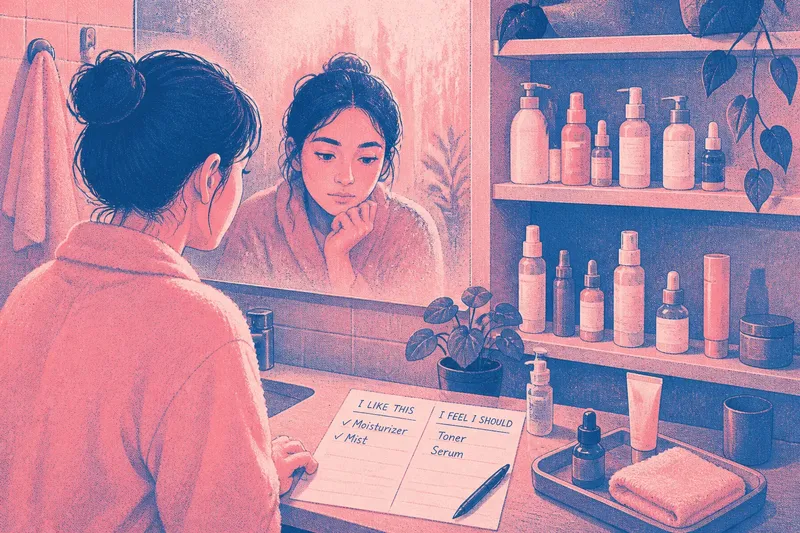
Maya’s bathroom mirror fogs after a shower, and she finds herself staring at a shelf lined with bottles she rarely uses in the same order. Her crowded skincare routine began with curiosity; now, the number of steps makes it hard to tell what she actually enjoys. A skincare routine does not become more attentive simply because it takes longer.
Say Maya’s starting point is a familiar cleanser, moisturizer, and daytime sunscreen, plus a toner, serum, exfoliating product, and face mist collected over time. She wants her skin to feel comfortable, but she also wants to understand the difference between a product she likes and one she uses because an online routine made it seem compulsory. She can examine that distinction without treating her shelf as a scorecard.
A crowded shelf can blur personal preference
Beauty content often turns routines into visible sequences: apply one layer, wait, add another, and repeat. That format can be satisfying to watch, but a polished sequence does not reveal whether its products suit another person’s preferences, skin, or schedule.
Maya notices that she likes the cool sensation of the mist, but not enough to remember it most evenings. She likes her moisturizer’s finish and reaches for it without prompting. The toner and serum are less clear: she cannot say what she expects from them, apart from having seen them included in routines she admired.
Those distinctions are about Maya’s experience, not universal judgments about the products. A product can be enjoyable without being essential, and a product with a compelling description can still feel irrelevant to the person holding it. The useful question is not whether a bottle deserves a place in every routine; it is what Maya genuinely wants from using it.
Separate enjoyment from beauty rules
Some steps belong because a person enjoys the texture, scent, finish, or ritual. Others are used to meet a specific personal aim. Neither reason needs to be disguised as a rule that everyone should follow.
Maya writes two columns on a scrap of paper: “I like this” and “I feel I should.” The mist goes under enjoyment, though she rarely reaches for it; the serum goes under obligation, because she cannot name a result she is seeking. Her moisturizer lands in the first column because she likes how her skin feels after applying it.
This small distinction changes the conversation from product ranking to self-knowledge. Maya does not have to prove that an optional product is useful to everyone. She only needs to decide whether its place in her own routine feels worthwhile, and whether the expectation attached to it is hers or borrowed.
Notice the experience, not just the label
Product labels and directions can explain intended use, but they cannot tell Maya whether a texture feels pleasant or whether a sequence feels like a chore. She pays attention to ordinary observations: whether a product feels comfortable, whether she looks forward to using it, and whether she feels pressured to continue just because she bought it.
If she notices persistent irritation, pain, swelling, or another worrying reaction, she should stop using the product and seek advice from a qualified health professional. Someone with a diagnosed skin condition, allergies, or a treatment plan may need individualized guidance. These observations are not a way to diagnose a reaction on her own.
For everyday preferences, she can be more specific. If a rich cream feels unpleasant before bed, that is a reason to reconsider when or whether she uses it; it does not establish a medical cause. A routine is personal in much the same way as a favorite mug: the point is how it works for its owner, not whether everyone else would choose it.
Questions that help distinguish taste from pressure?
Do I enjoy using this product?
Think about the texture, finish, scent, or feeling of the ritual, rather than the promise on the package. If you enjoy it and it suits you, enjoyment can be a complete reason to keep an optional step.
Am I using this because I want to or because I feel I should?
Notice whether a routine video, trend, or beauty rule created the expectation. If the reason is mostly pressure, you can pause and decide whether the step matters to you independently.
Does the product fit my preferences in practice?
Consider whether its feel and place in the sequence suit your ordinary day. If you consistently avoid it, that observation can prompt a choice to use it differently or leave it out.
What do I want this step to add to my routine?
Name a personal aim or a sensory pleasure, rather than reaching for a vague promise of a better routine. If neither comes to mind, you can set the product aside while you decide whether you want it at all.
A small review can make the choice clearer
Maya reviews each product with a short list of concrete observations. For every item, she checks what she likes or dislikes and makes a decision based on what she sees:
- If the product has a texture she enjoys and she reaches for it willingly, she keeps it as an optional pleasure; if she dislikes the feel, she sets it aside rather than forcing herself to use it.
- If the product’s place in her routine reflects a personal aim she can name, she considers keeping it; if its role comes only from a beauty rule, she pauses before treating it as necessary.
- If she uses the product because she enjoys the ritual, she keeps that preference in view; if she feels guilty when she skips it, she questions the pressure and may leave it out.
- If the product fits the time and setting in which she wants to use it, she keeps it accessible there; if it makes an ordinary evening feel cumbersome, she chooses a simpler arrangement or omits it.
- If the product feels comfortable to her, she can continue according to its directions; if she notices a worrying or persistent reaction, she stops and asks a qualified health professional for advice.
- If the product still appeals to her after she separates her own taste from outside expectations, she keeps it by choice; if the appeal disappears, she can stop treating it as part of her routine.
Imagine Maya looks again at her starting shelf and makes these choices: she keeps the moisturizer because she likes its finish, leaves the mist nearby for evenings when she wants its cool sensation, and sets the toner and serum aside because she cannot name a personal reason to use them. She continues with cleanser and daytime sunscreen as familiar parts of her routine. The observable result is not a promised change in her skin; it is a clearer sense of which products she chooses for herself and which she had been carrying as obligations.
Her decision is not a recommendation for everyone to use fewer products. It is a way to tell preference from performance: Maya can enjoy a step without calling it essential, and she can decline a trend without declaring it useless. A thoughtful skincare routine leaves room for that distinction, including the possibility that a product’s best place is on the shelf rather than in the sequence.
When another beauty routine catches her attention, Maya can ask what part of it appeals to her: the finish, the ritual, the color story, or simply the pleasure of watching someone arrange their products. That question lets curiosity remain enjoyable without turning every appealing shelf into a set of instructions.